Showing posts with label Garrus Vakarian. Show all posts

Friday, May 23, 2025

Mass Effect 3.


Original Release: Mar. 6, 2012 for XBox 360, PC. Playstation 3. Version Reviewed: PS4 Legendary Edition, 2021.


THE PLOT:

The day Commander Shepard has warned about has finally come: The Reapers have invaded. They first hit Batarian space, turning the survivors of the race that had been the scourge of the galaxy into scattered refugees. Their next target is Earth, and it isn't long before the massive enemy ships descend upon humanity's homeworld.

After months in prison for working with Cerberus to stop The Collectors, Shepard is now restored to a leadership role and given an impossible mission: Unite the other Council races, with all their grudges and prejudices and rivalries, into one massive force against the Reapers!

Getting the band back together: Shepard reunites with old squadmates. The ones who are still alive, at least.
Getting the band back together: Shepard reunites with old
squadmates. The ones who are still alive, at least.

CHARACTERS:

Commander Shepard: As with the first two games, the main direction of Shepard's journey is fixed. Within those boundaries, however, gamers again have freedom to shape the commander's personality. Shepard can be an inspiring hero, or angry and bitter, or worn down with exhaustion... or pretty much any combination. I started my Shepard with mainly "Paragon" speech options; then, as stress began taking its toll, I started to opt for more short-tempered "Renegade" options. This worked well... but it's far from the only option available.

Liara T'Soni: Mass Effect 2 greatly improved her characterization (along with most of the rest of the ensemble). Its Lair of the Shadow Broker DLC overhauled her role in the series, and that plays a big part here. Liara is strongly supportive of Shepard, with several scenes that gain added resonance if she's the selected love interest. Shepard is forced by circumstances to play politics, but it's an uncomfortable fit; Liara, who was born to that environment, is often able to assist. Her enthusiasm for the long-extinct Protheans remains as well, prompting some choice interactions with DLC character Javik. 

Kaidan/Ashley: The survivor of the first game's Virmire mission returns in a substantial supporting part. Refreshingly, though both Kaidan and Ashley fill the same role in the story, much of their dialogue is different. Kaidan talks about his students; Ashley worries about her family. Both cling to suspicions about Shepard's past ties to Cerberus, with voice actor Raphael Sbarge again making his resentment of that choice feel like something personal. I prefer Kaidan's scenes overall, but it's worth playing both versions.

James Vega: Is introduced as a hothead, arguing with Shepard over the choice to leave Earth, but he's also a generally decent guy. Unlike Mass Effect 2's Jacob, this is conveyed not by having people talking about how nice he is, but rather through his interactions: with Shepard, with the crew, and with shuttle pilot Steve Cortez. Voice actor Freddie Prinze Jr. proves a deft hand at comedy (ask James to do something techie on one of the Rannoch missions - the results are gold), but he also can dial that back to convey more serious emotions. Against my expectations, I ended up liking Vega a lot. It's a low bar, but I think he wins the award for "Best Human Squadmate" across the trilogy.

Samantha Traynor: Mass Effect 3 features what I believe was a Bioware first: two exclusively same-sex romance options. Unsurprisingly, the woman gets far more characterization. The good news is: She's a delight. Samantha Traynor, the Normandy's new Comm Specialist, is not someone who ever expected to be near combat. She's a tech nerd: hygiene-obsessed (with a very expensive toothbrush), a bit of a hypochondriac, and a chess and games enthusiast. Voice actress Alix Wilton Regan brings her wonderfully to life, and the character comes across as effortlessly likable.

Steve Cortez: The male same-sex counterpart is Shepard's shuttle pilot, and he basically has three traits: his longtime friendship with Vega, his piloting, and the death of his husband to the Collectors. Some of his interactions with James are amusing, and the Citadel DLC fleshes him out with a few more varied interactions. But there's a spark that Traynor has (and Mordin, and Wrex, and Garrus, and Tali, and... well, all the characters who really work) - and that spark just isn't there with Steve. I liked him just fine - but I'd be lying if I said I never pressed the "skip" button during his conversations.

Returning Characters: Garrus and Tali get interactions with Shepard and with each other that are a joy to watch. Tali's role builds on her loyalty mission in Mass Effect 2, with her position among the Quarians potentially very different depending on the results of that mission. Garrus's adventures with Shepard have made him the Turians' expert on Reapers. Artificial Intelligence EDI gets an expanded role - one which, on first playthrough, I was initially concerned would fall flat, but which ends up working well within the story. Wrex, Mordin, Thane, Legion, and Miranda don't re-join the crew, but they get decent supporting roles - particularly Mordin, who is at the center of the story's strongest arc.

Not all characters are equally well-treated. It's little surprise that Kasumi and Zaeed only receive cameos, as they were optional DLC characters in the first place. However, fan favorite Grunt is only seen in one mission; the same is true of Samara; the same is true of Jacob. The "Citadel" DLC makes up for this to an extent. In the core game, though, many previous "regulars" barely end up qualifying as walk-ons.
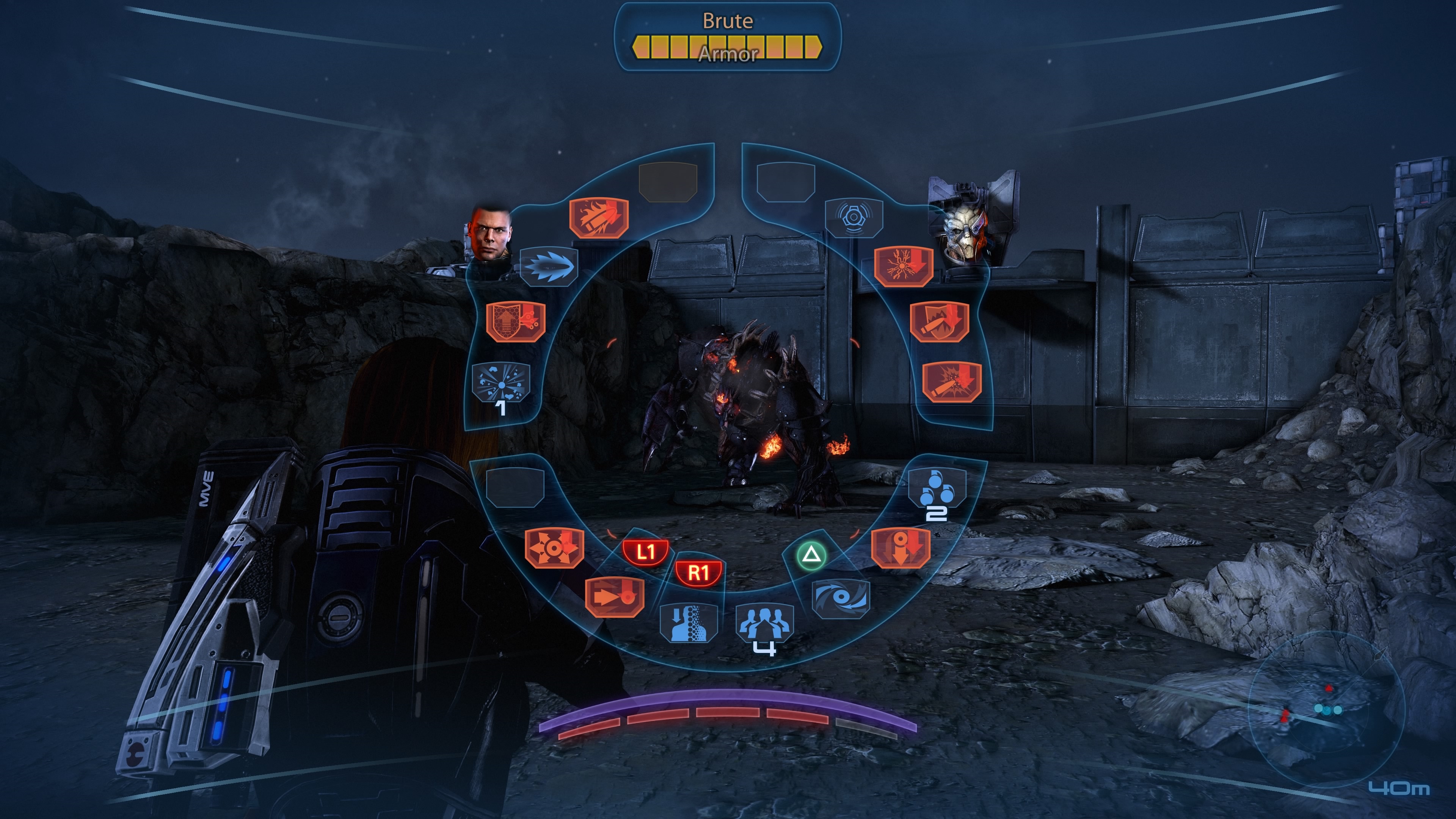
Shepard is charged by a Reaper creation known as a Brute.

COMBAT:

The combat in Mass Effect 3 is mechanically similar to the combat in Mass Effect 2 - which, as I noted, I didn't much enjoy. It's been tweaked, however. Controls are more responsive, and it's much more enjoyable as a result.

Darting from one piece of cover to the next is now keyed into button presses and direction controls, rather than having to be done manually each time. When in cover, you can also perform "quick kills" of enemies directly next to you. There's also an enjoyably overpowered feature: In battles involving Cerberus mechs, you can snipe the mech's pilot and hijack the machine, which will transform a tough battle into a one-sided slaughter.

In short, with just a few modifications, a combat system I gritted my teeth through in the previous game has been transformed into an absolute joy.


ADDITIONAL GAMEPLAY:

Mass Effect 3 pares back some of the dialogue options. In many cases, particularly when talking to the characters on the Normandy, no dialogue wheel appears; instead, the NPC will give a scripted comment about events. Full dialogue options are only presented for major interactions, rather than every time.

I have mixed feelings about this. On the one hand, doing the Normandy "rounds" in between missions is much quicker and easier. I do not miss clicking through the same responses over and over again just to find out if a given character has anything new to say. However, it also means that when a full conversation does become available, you pretty much have to have it then or lose it forever.

The planet scanning that was everybody's favorite (sarcasm) part of Mass Effect 2 returns. Fortunately, it's a lot less cumbersome. Instead of mining for resources, you are searching for a single target area, usually to fulfill a fetch quest received on the Citadel. There's also an element of jeopardy introduced, as Reapers will "detect" your scans and come after you... though it must be said that, for Lovecraftian dark gods, they are amazingly slow. If you want to see the Reaper "game over," you pretty much have to stop the ship to let them catch you!

Wrex and Mordin prepare for the Battle of Tuchanka... unless either or both died in the first two games.
Wrex and Mordin prepare for the Battle of Tuchanka...
unless either or both died in the first two games.

DEALING WITH PAST DECISIONS:

Mass Effect 2 already had to prepare variations of certain scenes to address some of the choices and events in the first Mass Effect. Depending on what was chosen and/or which characters survived, Shepard would encounter either Kaidan or Ashley on Horizon and either Wrex or his vicious borther Wreav on Tuchanka, resulting in differences in the scenes set on those worlds.

Mass Effect 3 continues this, but on a much larger scale. Instead of a cameo, Kaidan/Ashley gets a major supporting role. Wrex/Wreav also has a substantial role, and these two characters couldn't be more different. Wrex wants the Krogan to be a part of galactic society; Wreav wants revenge for wrongs perpetrated on his people. Given the implications of their respective outlooks, you might entirely reconsider one major choice if Wreav leads the Krogan instead of Wrex... and you might well be right do so!

Any of Mass Effect 2's squadmates could die at the end of that game. That leaves Mass Effect 3 to come up with two variations for eleven different characters. This is comparatively simple for those who only receive cameos: The mission in which they appear plays out either with an NPC stand-in or just without that character.

Other replacements are more significant. If Mordin died in Mass Effect 2, then Padok Wiks, another Salarian scientist, takes his place. It's well worth doing a playthrough to see this variant, as Padok is an excellent character in his own right. He fills Mordin's role in the story, but he is very much his own man. He's less humorous and is also less of a pragmatist. Mordin defended the genophage as a necessary evil; Padok considers it a wrong, insisting that every species has value. Mordin develops a friendship with the female Krogan, Eve; Padok and Eve have "an agreement not to kill each other."

If Tali died in the Suicide Mission, then her role in the Rannoch campaign is filled by the Quarian admirals. This takes one potential resolution to the conflict completely off the table. In addition, it creates a noticeably darker atmosphere. Without Tali, there is no Quarian whom Shepard can fully trust.

Shepard struggles toward the Reaper skybeam. Because you can't have an apocalypse without a skybeam.
Shepard struggles toward the Reaper skybeam. Because
you can't have an apocalypse without a skybeam.

AN UNWORTHY ENDING:

When Mass Effect 3 was first released, it didn't take long for the discussion to focus on one aspect: the ending. Particularly in its original form, the ending was... really, really bad. So bad that within weeks, Bioware released a free "Extended Cut" DLC that patched it with multiple improvements - which has not stopped it from becoming one of the most infamous endings in video game history!

You'd just about have to try to play the ending in its original form anymore, so I'll briefly describe it. Fear not; there are no meaningful spoilers. Shepard makes the game's final decision, whose momentous consequence is... What color explosion happens: Red, green, or blue. This is followed by a brief, wordless scene in which Joker and another character will climb out of a crashed Normandy to stare pensively into the distance. Roll credits!

In its patched form (the only one available on the Legendary Edition re-release), I wouldn't label it a disaster. The focus of the decision ties in with a recurring theme of the trilogy, one that's particularly relevant in the third game. More context is given to the final choice, with more dialogue options for Shepard.  There is also an epilogue that shows the effects of Shepard's choice, making use of the individual decisions you made prior to that point, allowing for: which characters and races survived; various power dynamics, from whether a bomb was stopped to whether a peace agreement was reached; how successful Shepard was at accumulating war assets; and whether Shepard followed a Paragon or Renegade path. There's even a stealth fourth option.

Had this care been taken in the first place, I suspect much of the outcry would never have happened. That said... Even in its current form, Mass Effect 3's ending is its single weakest aspect. It doesn't nullify the roughly fifty hours of very good story and gameplay that precedes it. Still, you tend to remember the final impression left by a book, movie, or game - and Mass Effect 3 does not leave a very good final impression.

Tali pays her respects to a fellow Quarian who
reached his homeworld, only to die in battle.
Tali pays her respects to a fellow Quarian who
reached his homeworld, only to die in battle.

OTHER MUSINGS:

Despite that weak ending, Mass Effect 3 is still my personal favorite of the trilogy. It has the best combat. It features several of the best character interactions, including some of the most emotional moments in the series. It delivers an effective sense of dread that builds steadily and is felt even during the humorous moments.

The use of the Citadel is more or less what Dragon Age 2's Kirkwall should have been, in that it changes throughout. Early in the game, C-Sec Commander Bailey complains that people keep behaving as if everything is normal and there is no war. Each return sees the Citadel's situation deteriorating. The hospital goes from clean and mostly empty to so busy that patients are on stretchers in the halls. A holding area is assigned for refugees from overrun worlds, and it grows increasingly crowded. Background conversations show people first becoming aware of the war - and then becoming afraid.

Then there are the background conversations, which provide miniature narratives. A human soldier, disowned by her family after marrying an Asari, desperately tries to get her daughter to her spouse's family on Thessia before she ships out. A Volus merchant bloviates to a naive human woman about his certainty that the supposedly safe colony world of Sanctuary is a giant scam. An Asari commando grapples with memories of a Reaper attack on a world she was evacuating. A young refugee forms a bond with a Turian guard while waiting, with increasing hopelessness, for her family to arrive. And many others, ranging from amusing to touching to horrifying.

Not all of these vignettes work. The conversations between a military wife and her Asari lover, who urges her to leave her husband while he's on the front lines, mainly left me wanting to show both ladies to the nearest airlock, for example. Still, these background stories combine to create a mosaic of the war's impact on people whom Shepard would otherwise never meet.

An Asari falls to a Reaper creation, in an image straight out of a horror movie.
An Asari falls to a Reaper creation,
in an image straight out of a horror movie.

A FEW SIGNS OF RUSHED DEVELOPMENT:

I have no substantial complaints about the first two thirds. Not every mission is equally well designed, but that's been true of every game in the series. Up through the Rannoch arc, the story is well structured. There's a nice sense of rising action, with Shepard gradually gathering allies and notching a few big victories - but always at a cost, which helps sustain the grim tone even when calling down an air strike on a Reaper. There's a mix of shorter missions and more extensive mini-campaigns. There's a sense that the story is building the way that it should.

As the story approaches its later stages, the tight deadline starts to show. A key part of the late story brings Shepard to Thessia, the homeworld of the Asari, who are the most advanced civilization and who have been one of the most prominent alien races throughout the series. You would expect an arc of missions, as happened with the Krogan on Tuchanka and the Quarians on Rannoch. Failing that, you would at least expect an extensive, multi-stage mission with multiple dialogue breaks to absorb different facets of Asari culture - as, again, happens with both Tuchanka and Rannoch.

Nope. Thessia is one of the shortest and most linear missions of the game. Shepard takes a short walk across a bridge, down a ladder, and up a corridor, fighting routine enemies along the way. There are some good observations and interactions at the destination (particularly if you bring Javik) - but it's far from enough to disguise how rushed the entire sequence is. Both the revelations and the emotional follow-up would have meant far more had it been more of a fight to get there. I strongly suspect this was a case of the deadline forcing the developers to create something shorter and simpler than was ideal.

Earlier, I discussed how well this game does in "catching" most of Shepard's potential decisions. There are a couple of exceptions. Players who picked Morinth over Samara in Mass Effect 2 are treated to... zero alternative Morinth scenes or interactions. All that happens is that Shepard receives one email early in the game, before eventually running into a standard enemy labeled "Morinth." Something similar happens if Legion was sent back to Cerberus. It's disappointing, as I suspect interesting variations could have been created. However, in both cases, the percentage of players making those choices was probably extremely small. As the deadline loomed, I expect that more fully addressing those routes was sacrificed to making sure that alternate paths for Tuchanka, the Citadel, and Rannoch were properly available.

A Turian watches helplessly as his planet burns.

OVERALL:

Yes, the ending is weak, even if its current form isn't the disaster of the original release. Yes, the developers should have had a three-year development cycle, as with Mass Effect 2, rather than being forced to squeeze the series' most ambitious title out in a mere two years; and yes, that deadline starts to show in the later stretches.

For all of that, I mostly love Mass Effect 3. I love the character interactions. I love the background conversations. I love the fact that, even if your past choices have minimal effect on the ending, they are addressed through noticeable variations throughout the game.

If the ending wasn't so wobbly, this would get full marks even with the other issues. Even as it stands... This is my favorite game in my favorite video game series. There's no question that I'm rating it highly.


Overall Rating: 9/10.

Mass Effect 3 DLC

Previous: Mass Effect 2
Next: Mass Effect - Andromeda

Review Index

To receive new review updates, follow me:

On BlueSky:

On Threads:

Mass Effect 2


Original Release: Jan. 26, 2010 for XBox 360, PC. Version Reviewed: PS4 Legendary Edition, 2021.


THE PLOT:

In the aftermath of the attack on the Citadel, Commander Shepard and the Normandy are sent to deal with the remaining pockets of enemy Geth. This mission comes to an abrupt end when they come under attack by an unknown enemy, a vast ship whose weapons cut through the prize of the Alliance fleet like a knife through butter. Many among the crew survive, making it to escape pods... but Shepard is killed.

Enter Cerberus. Once an Alliance black ops unit gone rogue, it has become a private entity. It's still officially despised, but it's also well-connected and remarkably well-funded. Cerberus's leader, the Illusive Man (Martin Sheen), shares Shepard's concerns about the Reaper threat, and has given top operative Miranda Lawson (Yvonne Strahovski) essentially unlimited resources to bring Shepard back to life, with no alterations in either memory or personality.

Two years later, these efforts bear fruit: Shepard wakes up in a Cerberus lab. Though wary about working with Cerberus, Shepard cannot ignore the crisis. A mysterious race known as "The Collectors" has been attacking human colonies, leaving each world devoid of survivors or even corpses. Their objective is unknown, but the Illusive Man suspects a connection with the Reapers.

Given command of a new and improved Normandy, Shepard begins gathering allies to attack the Collectors where they live. Then an encounter with the enemy results in a startling revelation: It was the Collectors who destroyed the first Normandy two years earlier. And that is only the first of the surprises to come...

Shepard reconnects with some old friends - and makes a few new ones along the way.
Shepard reconnects with some old friends -
and makes a few new ones along the way.

CHARACTERS:

The single largest improvement made for Mass Effect 2 is in the characters. Returning cast members are more sharply defined than in the first game. Liara and Tali, who were both portrayed too much in "babe in the woods" terms, are remade as decisive individuals. Liara has shifted from archaeologist to information broker, better positioning her to be a key part of the story, and she shows flashes of ruthlessness. Tali is now leading missions for the Quarian migrant fleet, and she is more assertive and decisive than before. Kaidan and Ashley, the least interesting members of the first game's crew, appear only briefly, but they are also much improved. Raphael Sbarge's Kaidan is particularly strong in his major scene, reacting to Shepard's new association with Cerberus as if to a personal betrayal.

Several new characters are introduced. My personal favorite of these is Mordin Solus, a brilliant Salarian scientist whose chipper attitude hides mixed emotions about his past work; he vigorously defends his previous work adapting the Krogan genophage, but he seems to be trying to convince himself as much as Shepard. Dying assassin Thane is haunted by the death of his wife and by his estrangement from his son, and his species (the Drell) is blessed/cursed by the ability to re-experience memories as if living them for the first time. Krogan Grunt has no real layers, basically wanting to just smash things and fight enemies, but that very simplicity makes his every line and action fun. Finally, Tricia Helfer's EDI, the Normandy's "shackled" AI, proves to be a dryly humorous delight, particularly when paired with Seth Green's Joker.

Not every character engaged me. Miranda is well-scripted, with her own issues and contradications, and actress Yvonne Strahovski is good in the role. That said, across multiple playthroughs, I have never once found the character compelling, and her default outfit is the kind of video game fanservice that always annoys me. Justicar Samara is also well-voiced and well-scripted, and is also a character I just don't connect with. Meanwhile, Jack - the edgy, tough loner of the crew - seems to have been precisely scripted to hit every character beat that I find grating. All she's missing are the daddy issues (which were given to Miranda and Jacob).

Speaking of Jacob... I think he's meant to be this game's Kaidan: the primary male supporting character and default love interest for female Shepards. I suspect most female Shepards hold out for Garrus... or Thane... or Liara in a DLC... or celibacy. Jacob is so bland that I took to avoiding the ship's armory to limit my interactions with him. Suffice it to say: Two games in, and Mass Effect has its worst character, one that I suspect the series is unlikely to outdo.

Cover shooting hordes of generic enemies before advancing to the next room. There is FAR too much of this.
Cover shooting hordes of generic enemies before
advancing to the next room. There is FAR too much of this.

COMBAT:

Unlike the first Mass Effect, the second game's combat was not adjusted for the Legendary Edition re-release. This may be unfortunate, at least from my perspective, as I am no fan of Mass Effect 2's combat.

There are minor but persistent control issues. To reliably enter cover requires the press of a button - the same button used to vault over objects. For me, at least, this too often resulted in me attempting to duck into cover and instead jumping over it into enemy fire. In addition, squadmates will intermittently ignore your commands. Having to order Mordin to "Burn" an enemy three times before he actually does it is annoying - particularly when that enemy is in the process of charging me!

Even more irritating is the structure of the battles. Mass Effect 2's combat is extremely repetitive, at least in the main game (some of the DLCs improve on it). Every battle seems to invoke "horde mode," with the player crouching behind cover to recharge shields while blasting through wave upon wave of generic bad guys.

There's not even much challenge to most of this. You take cover and snipe enemies for ten minutes or so until the field is clear. Then you advance to the next room, where you take cover and snipe enemies again. Eventually, you'll get to a boss... whom you will almost invariably defeat by taking cover and sniping it - though some bosses mix it up by making you run from one bit of cover to the next in between taking your shots. After the boss is defeated, you are rewarded with a cutscene. The game rarely deviates from this structure, and after while it becomes... well, boring.

The most enjoyable part of the gameplay: Making choices that affect the story.
The most enjoyable part of the gameplay:
Making choices that affect the story.

ADDITIONAL GAMEPLAY:

RPG elements have been greatly stripped back from the first game. This isn't all bad. The first game had a cumbersome inventory system, one which would periodically send me combing through my gear to "reduce to omnigel" all low-level items. That's gone here; when you pick up a higher-level item, it effectively replaces the lower-level version, and you can change and upgrade gear between missions. It's cleaner and quicker, and nothing of value is lost.

The streamlining does carry some disadvantages. There are fewer skills in Mass Effect 2, which gives players less ability to customize characters. You cannot swap out armor. You can adjust a few things, such as an armor's shoulders or textures - but only for Shepard, and not for any of the companions.

The most enjoyable aspect of the game remains making choices. How Shepard responds to situations and conversations can change squadmate loyalty and even the results of individual missions. More often, these decisions are cosmetic, but they still give you a chance to decide who your Shepard is. Whether your Shepard is wary of Cerberus or completely drinks their "pro-human" Kool-Aid has little affect on the story, but it will change the way you view the overall experience.

Finally, an enhancement has been added to the Paragon/Renegade system: interrupts. During cutscenes, a blue Paragon symbol or a red Renegade one will appear on screen. Pulling the appropriate trigger will change the direction of the cutscene. Paragon interrupts will usually involve trying to peacefully resolve an issue or offering comfort; Renegade interrupts involve more direct action, with often very entertaining results.

A Quarian tribunal. Hypocrisy is not exclusive to humanity.

A MORE LIVED IN AND CINEMATIC UNIVERSE...:

Mass Effect 2 does important work in terms of making its fictional universe feel more textured and lived in. The dialogue is sharper, the characters feel more alive, and we get more of a sense of the internal conflicts and divisions within each culture.

The first game mentioned the Krogan homeworld and the Quarian fleet; this game takes us to both places, revealing the petty rivalries and hypocrisies that exist there. In the first game, Liara mentioned that Asari "pure bloods" such as herself are looked down upon. This game expands on that, introducing the Ardat-Yakshi, who are Asari suffering from a genetic disorder that is deadly to those they come into contact with, and that is also exclusive to pure bloods. Even the Geth get additional development, as we learn that these AI enemies are far from the monolith the first game had implied.

Visuals are more cinematic. Cutscenes simulate zooms, rapid pans, focus shifts, and even handheld camerawork at various points. Even in-engine visuals feature more detail in backgrounds, with a more generally dynamic use of color, and (this being 2010) J. J. Abrams-style lens flare. The trade-off comes with a few too many corridors and office buildings; but there's no question that this game draws you in visually much more strongly than the first one did.

Shepard's new enemy: The Collectors. The game could have used more of them.
Shepard's new enemy: The Collectors.
The game could have used more of them.

...BUT NOT WITHOUT ITS PROBLEMS:

While this game makes me feel more connected to the characters and their universe than the first one did, there are issues that hold it back from being a triumph. I've already mentioned the combat structure, which is repetitive to the point of tedium.

There's also Yeoman Kelly Chambers, a supposedly highly trained psychologist meant to help Shepard gain insight into the crew. She gains new dialogue every time a crew member is added. Unfortunately... Well, let me paraphrase 80% of what she says: "I'd like to sleep with you, him, her, and it!" I suspect even some twelve-year-old boys playing this began wishing for her to give it a rest.

Mass Effect 2's biggest issue, however, is its plot.

The story is basically this: Shepard recruits a group of misfits from various backgrounds; they gradually become a team; and they embark on a mission where death seems the most likely outcome. Yes, it's Seven Samurai in space. This is a perfectly fine template, and the characters' loyalty missions help to fill in a lot of detail about the various races of Mass Effect. But there are too many characters, and their issues are mostly unrelated to the Collector plot - and after a while, the Collectors start to feel practically like an afterthought.

For the first third or so, the game does a decent job of balancing the character missions with story progression. The first full mission establishes the Collectors as a threat. An early recruitment mission namechecks them. After you've recruited about a third of available characters, the story advances by having you deal with a Collector attack. After another handful of missions, you encounter the Collectors face-to-face, at which point a massive plot twist is revealed.

And then... nothing. This is the approximate midpoint of the game - and at this point, it will take most players a good 15 - 20 hours before the Collectors are a factor in any way other than an occasional namecheck. I can't help but feel that one more beat was needed to keep them alive as a threat.

A major contributor to this problem is cast glut. A couple of squad members are optional; other squad members can die. As a result, the game developers had to build some redundancy into the final mission. Unfortunately, if you add in DLC characters Zaeed and Kasumi, you can (and I suspect most players will) go into that final assault with eleven squad mates. The nine main game squad members have two missions each: one for recruitment, one for loyalty. Zaeed and Kasumi receive one mission each. That comes to a total of twenty missions!

Don't get me wrong: Some of these missions are very good, and a few are even great. Tali's loyalty mission may be my favorite part of the game; Mordin's isn't far behind, with some outstanding character writing and superb voice acting by Michael Beattie; and Thane's mixes up the gameplay with a fun stealth section. Others are... less good. The real problem isn't variable quality, however. The problem is that all of these missions end up feeling like individual episodes, as if from a weekly television series. Twenty such episodes is a bit much, and the sense of urgency so well created in the early levels can't help but be drained away.

The Normandy crew plans its final assault.

THE FINAL MISSION:

All of that said, the main game ends with an absolute triumph: The assault on the Collector Base. This is the mission the entire game has been building toward, and everything about it works.

First, it acts as a synthesis of all the choices you've made throughout the game. Which (if any) upgrades you made to the Normandy will determine how the approach to the base goes. If you skipped that annoying scanning mini-game, then be prepared to start the mission with a half-wrecked ship and a depleted squad. From there, choices you've made that have either gained or lost the team's loyalty will affect how each phase of the mission goes.

Oh, and if you did everything perfectly up to this point? You can still lose squad members if you assign the wrong people to critical roles during the mission. In some cases, the assignment calls are easy - but other cases come down to multiple seemingly valid options, not all of which will net an ideal result.

Add in a terrific, adrenaline-pumping score, a last moral decision, and a final boss that offers one of the game's few reasonably imaginative battles, and this entire sequence is a masterpiece.

Mordin sings, in one of many fine character scenes.

OVERALL:

I have very mixed feelings about Mass Effect 2. It is definitely a good game overall, and the series is much the better for its existence. It improves on its predecessor's characterizations, expands and deepens the fictional universe, and delivers a more cinematic look.

I think it falls short of being a great game, though. There are too many squadmates, and I think there would be more focus if 2 - 3 characters had been culled. The combat is so repetitive that it quickly becomes tedious, and about half the game's running time is spent in that combat. Finally, the Collector story loses momentum as it vanishes for entirely too many hours of the mid-game.

The good outweighs the bad, and the main game ends on a high note after a final mission that is a triumph of good game design. Still, if pressed (and if memories of the third game hold), I would likely label this as my least favorite of the trilogy.


Overall Rating: 7/10.

Mass Effect 2 DLC

Previous Game: Mass Effect
Next Game: Mass Effect 3

Review Index

To receive new review updates, follow me:

On BlueSky:

On Threads:

Mass Effect.


Original Release: Nov. 20, 2007 for XBox 360. Version Reviewed: PS4 Legendary Edition, 2021.


THE PLOT:

In the late 22nd century, humanity has become part of an inter-species galactic civilization. All these species are joined together by a series of mass relays, left behind by the long-dead Prothean civilization, which enable faster-than-light travel between star systems. Order is maintained by the Council, a ruling body that operates out of the Citadel, a vast space station that acts as the galactic capital. Thus far, the Council has refused to allow the humans a voice in the larger government, and resentment is starting to brew.

The council has decided that it is time to recruit a human as a SPECTRE - the Council's elite enforcement agents, answerable only to them. The selected candidate is Commander Shepard, First Officer of the Normandy, an advanced vessel that combines elements of human and Turian design. Shepard's evaluation coincides with a mission to recover a beacon, a Prothean artifact, that has been found on the human colony of Eden Prime. No trouble is expected.

But the Normandy arrives to find Eden Prime under attack by the geth, a race of intelligent synthetic beings. The geth are led by Saren - the Council's top SPECTRE. Shepard manages to stop them from taking the beacon, but is exposed to it in the process, granted an apocalyptic vision.

Now Shepard must convince the Council of Saren's guilt and track the rogue SPECTRE across the Mass Relay network. The clock is ticking. If Saren isn't stopped, it will mean the end of galactic civilization...

The crew of the <i>Normandy </i>encounter some local resistance.
The crew of the Normandy encounter some local resistance.

CHARACTERS:

Commander Shepard: The game gives the player a lot of freedom regarding Shepard. It's a Bioware standard that the character can be either male or female. Beyond that, Shepard has three potential origin stories and three different career backgrounds, both of which will affect dialogue choices and a couple of side missions. There are a mix of dialogue options that can shape Shepard's personality, from compassionate to ruthless, from idealistic to cynical, from diplomatic to combative. I opted for a balanced mix of responses; there are more than enough opportunities to earn "Paragon" (Light Side) or "Renegade" (Dark Side) points, so players should feel free to just decide who their Shepard is and respond accordingly. Even the most "Paragon" of players should hang up on the Council at least once during the playthrough, because: (a) It's funny; and (b) They really have it coming.

Saren: The game's primary antagonist, a rogue SPECTRE who despises humans, whom he feels have been given too much power too quickly. Saren is far from alone in that feeling, and in this first game there is a sense that humans are very much an underdog among the various races (something that, if memory serves, would be lost in later games). Saren initially appears to be a mustache-twirling "Evil for the Sake of Evil" baddie. He gains some depth in the late game, however, as more information about his motives and his state of mind become clear. Voice actor Frederick Tatasciore is terrific in the role, threatening and formidable without being one-note.

Liara T'Soni: One of the most purely innocent members of your party, she is also the daughter of the Asari matriarch who acts as Saren's right hand. She is estranged from her mother, insisting that she knows nothing of her actions. She is also an expert on the extinct Prothean civilization. The character is a bit too naive and earnest in this first installment, though she still gets some good moments, particularly if you bring her along to confront her mother.

Garrus Vakarian: A former member of C-Sec, which is basically the police force on the Citadel. Garrus grew impatient with the layers of bureaucracy that he had to deal with, which he felt interfered with him actually stopping criminals. He is one of the game's better characters, and players get the opportunity to nudge his outlook in one direction or another depending on dialogue choices. The scene in which he (likely) joins the crew also is the single best character introduction in the game.

Wrex: Most of the rest of the characters in Mass Effect improve in later entries (even Garrus); Wrex arrives fully formed. He is a Krogan, a warrior-like race that rose up against the Council generations ago - an uprising that ended when the Council afflicted them with the genophage, a genetically designed plague that caused near sterility. Wrex is understandably bitter, but he is also angry at his own people for refusing to adapt to their circumstances. In one of the first conversations you have with Wrex, he reveals that he "gave up on (the Krogan) a long time ago."

Tali: A Quarian, a race that lost its home to the Geth hundreds of years ago - and that has found little sympathy among Council races, because the Quarians are the ones who created the Geth. They now live among a vast fleet of aging ships. Young Quarians are sent out on pilgrimages when they come of age, returning with something of value to prove their worth to the fleet. Tali, the daughter of a fleet admiral, is determined to prove herself by returning with something of genuine worth - and it's that quest which leads her into Saren's sights.

Kaidan/Ashley: The final two members of the crew are humans - and following a long sci-fi tradition, the humans are by far the dullest characters. Kaidan has an interesting backstory, as his biotic abilities led to a life of harsh training that made him a test subject in all but name. This should make him interesting... but all conversations just amount to him narrating his past, none of which has much impact on the present.

Ashley is even worse. She is from a career military family, though one that has been discriminated against in the ranks ever since her grandfather surrendered to an enemy rather than allow civilians to die. She harbors resentment against aliens as a result, leading many in fandom to dismiss her a "space racist." Oh, and she quotes Tennyson. A lot. Too much. Both voice actors (Raphael Sbarge, Kimberly Brooks) do a fine job, but I couldn't make myself care even a little bit about either of them.

Combat is satisfying and intuitive - and greatly improved in the Legendary Edition.
Combat is satisfying and intuitive -
and greatly improved in the Legendary Edition.

COMBAT:

Mass Effect may be the earliest Bioware game to have reasonably satisfying combat. Even in its original version, it was an engaging cover shooter. It's easy to enter in and out of cover, and aiming and firing are entirely intuitive. There are several types of weapons available, from assault rifles to shotguns to sniper rifles, and it's easy to switch between guns by bringing up the weapons wheel with a click of the left bumper.

The right bumper also brings up squad members' biotic abilities, allowing you to lift, throw, or otherwise afflict enemies even as you're shooting them. Attacks can be combined to devastating effect; Liara's Singularity ability, once fully upgraded, is a gamechanger, with her able to send giant Geth Colossi floating around helplessly for you to use as target practice.

The Legendary Edition improves on the original combat. Aiming is noticeably more stable. The sniper rifles - which were so juddery as to be practically useless in the original version - are now arguably too effective; using sniper rifles basically amounts to playing on Easy Mode, even with the difficulty on maximum.

A battlefield conversation with Saren: Dialogue options can 
shape characters and, occasionally, mission results.
A battlefield conversation with Saren: Dialogue options can 
shape characters and, occasionally, mission results.

ADDITIONAL GAMEPLAY:

This is a Bioware RPG, which means that combat is less than half of the total gameplay. Players will spend a lot of time shooting and zapping various enemies, but they will spend even more simply exploring and learning about this fictional universe, discovering various NPCs and side quests along the way.

Mass Effect's main plot is quite linear, but a lot of flexibility has been built into the individual quests. You can save individuals, or you can choose to sacrifice them. In the case of one side quest, involving a woman tangled up in organized crime, you can talk her into severing those ties, fight her, or demand your own piece of the action. A main quest that involves gaining access to a research laboratory has at least three different paths to follow; all of them will get you to the same destination, but the journey will be just a little different depending on what you do.

Your first in-person look at a Reaper -
not that Shepard even knows what that is yet...
Your first in-person look at a Reaper -
not that Shepard even knows what that is yet...

AN ADMISSION OF BIAS:

The original Mass Effect holds a special place for me. I first played it in 2012. Before then, I regarded video games as a lesser art form. Even when I enjoyed a specific game (such as the first two Fallouts way back in the 1990s), no title had ever drawn me into its world in the same way that good books, movies, or television programs had done.

Then I played Mass Effect, and I was stunned by the quality voice acting, the solid plot and characters, and the detailed and internally consistent universe. I was gripped and even emotionally engaged. By modern standards, it's not a long game - about 40 hours, including DLC, and that's if you complete all the side quests along the way. But at the time, to a relative non-gamer, it felt as enormous as it was immersive.

The Mass Effect games led me to Dragon Age... and then to Knights of the Old Republic... and then to the Fire Emblem and Persona franchises... and somewhere along the way, I had to acknowledge: (a) that I had become a gamer, rather than someone who occasionally noodled at a video game; and (b) that my previous dismissal of an entire medium had been, to put it mildly, a bit premature.

Driving the Mako through an alien warzone.

OTHER MUSINGS:

Even accounting for the special place this game holds for me, I'd still say that it holds up well overall. The main plot is well-paced. If you play the story missions in the order that the story pushes you toward, there is a distinct sense of rising stakes as you move from combating Saren's drones and hired muscle, to battling a trusted lieutenant, to finally coming face-to-face with the villain himself.

To the game's credit, it has alternate scenes and dialogue options for those who choose a different sequence (the alternate "finding Liara" scene is quite entertaining), but the default mission order is also the most dramatically satisfying one.

There are a wealth of side quests, and some of these mini-stories help to flesh out the universe. The actual gameplay structure gets a bit repetitive, though. You land on either a planet or a spaceship. If you're on a planet, you drive to three points to scan objects before going to the main destination - a prefabricated station that always has the same layout, and whose enemies usually follow the same attack pattern. If on a spaceship, then you go through the same entry hall before fighting enemies in the main corridor, and then you find the plot point in the cockpit. Even when the side quest's story is interesting, the structure is uninspired - particularly compared to the varied and richly detailed main story missions.

The Legendary Edition is a substantial improvement over the 2007 original - I didn't realize just how much of one until I fired up my old XBox 360 version to replay the "Pinnacle Station" DLC (which is not included in the remaster). In addition to combat improvements, the visuals have received a significant overhaul. Characters and environments are much more detailed, and cutscenes look more cinematic.

The additional detail is particularly evident during planetary explorations. You can now tell which surfaces can and can't be driven on, which makes driving the Mako less aggravating than it used to be. I suspect enhancements will be less noticeable in later games, given that Mass Effect 2 and 3 still look pretty good by modern standards, but the difference in the original is practically night-and-day.

Shepard and the Normandy crew discuss their options.

OVERALL:

Mass Effect was the last of the three original IPs that Bioware released when it decided to move away from established franchises, following Jade Empire and Dragon Age: Origins. Along with Dragon Age, the Mass Effect series has become the property the company's most associated with.

It's also a rather good game. Even in the Legendary Edition, there are aspects of the 2007 original that show its age - notably the repetitive side quests. The main story remains solid, however, and the main story missions are varied and engaging. More than fifteen years after its original release, this fictional universe remains a place well worth spending some time in.


Overall Rating: 8/10.

Mass Effect DLC

Next Game: Mass Effect 2

Review Index

To receive new review updates, follow me:

On BlueSky:

On Threads: